
Dinton's Daffodils
A visit to Reverend George Engleheart's village.

Last time, I wrote about Ellen Willmott’s love for Narcissi and how she became friends with and corresponded with the Reverend George Engleheart, who at the time lived in Applshaw, Andover. He later moved to the village of Dinton in Wiltshire.
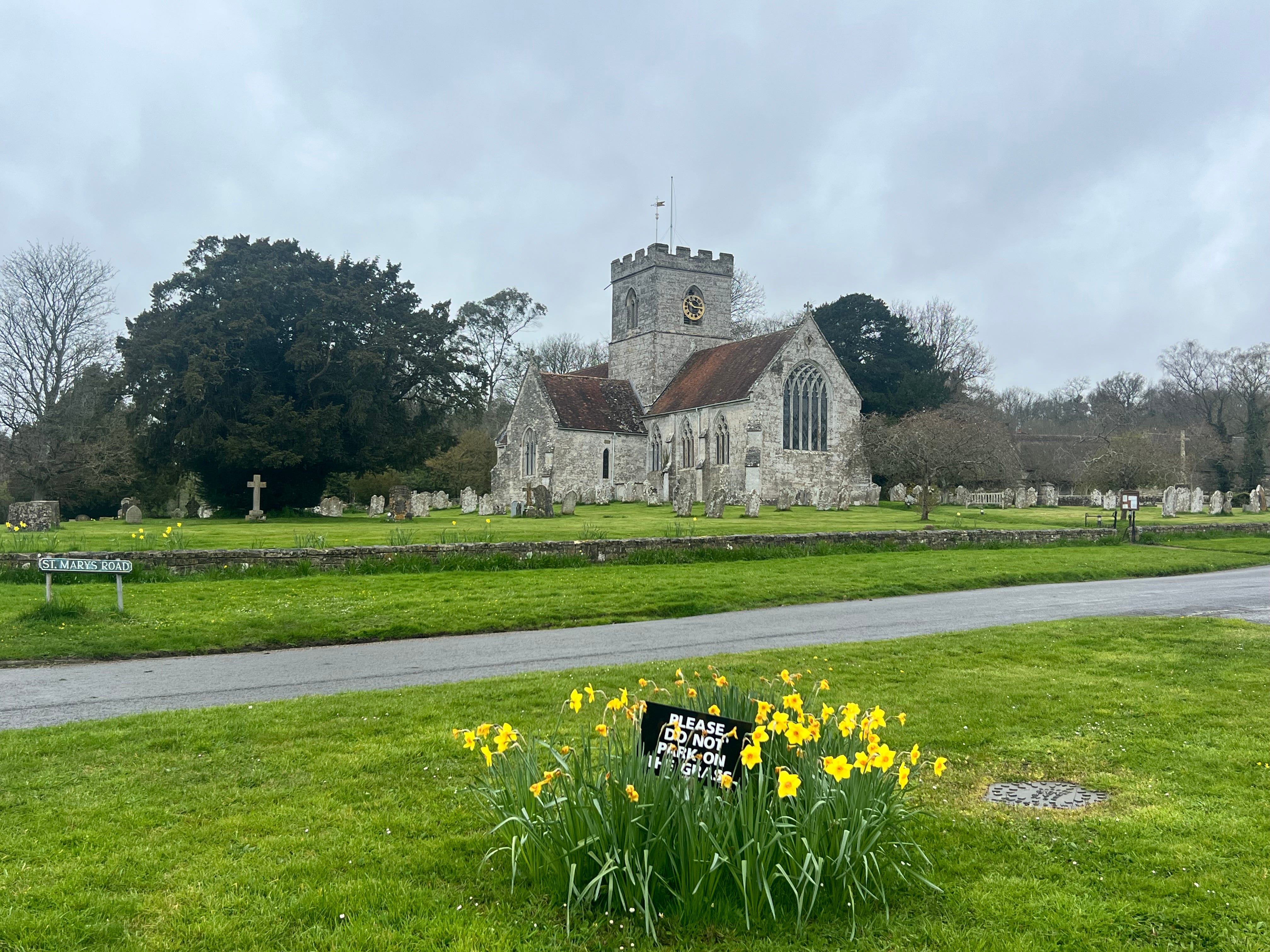
Last Friday, I was going to visit one of my fellow trainee speakers in Wiltshire. I decided to leave home early and detour into Dinton on the way there. It was a nice day, and Dinton turned out to be a pretty little village. Sure enough, there were various verges and green spaces, planted with different varieties of Narcissi. I did wonder what any locals thought of me taking photos of the daffs on their verges. But I’m sure that anyone involved in the Dinton Daffodil Project would have appreciated my interest.
Unfortunately, there were no labels or signage, so I had no way of knowing what the varieties were. I shall do a bit of research on that front. It may be tricky, though, as George registered about 700 different varieties between 1882 and 1932. Names such as ‘Beersheba’, ‘Helios’, ‘Albatross’, ‘Evangeline’, and ‘Great Warley’, as well as the now lost ‘Ellen Willmott’ (Such a shame). But online, I have just spotted a rather lovely variety called ‘Tresserve’, named after Ellen’s French home.
The Rev. sold three bulbs of one of his early Varieties, ‘Will Scarlet’, for £100. A huge amount of money at the time. There doesn’t seem to be any record of who made the purchase.


I stopped several times to take photos, but eventually drove on and found St Mary’s Church. It was in a lovely setting with lots of space around it and an old stone retaining wall with purple aubrietia spilling over it in places. I parked up and had a wander around the churchyard in the hope of spotting a grave surrounded by a ‘Host of Golden Daffodils’, but sadly, no one has thought to mark the Vicar’s final resting place in what would have been a most appropriate way. So I didn’t spot his grave.


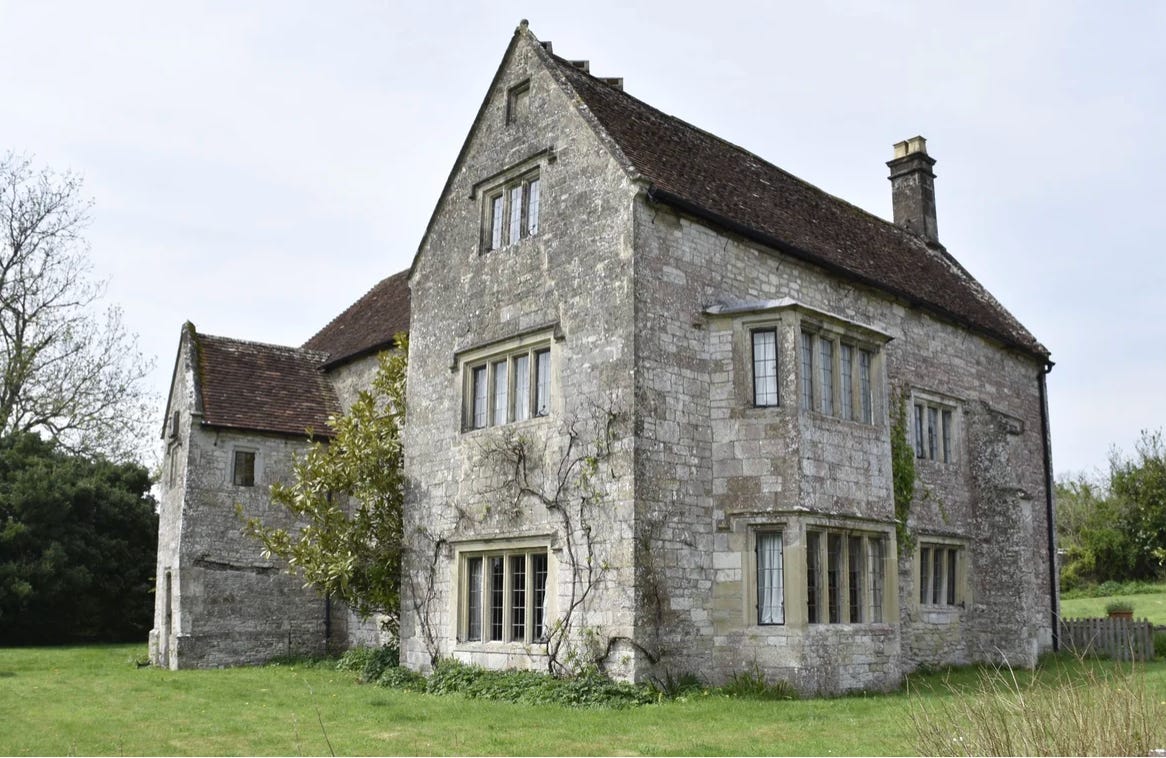
I then drove on and found the National Trust sign for his home, Little Clarendon. I had already checked and knew that, sadly, it wouldn’t be open. I had hoped to catch a glimpse of the house. Unfortunately, it wasn’t visible from the locked gates. According to the National Trust website, the house is only open to the public for a few hours a year, so I will have to be very determined if I want to see inside.
From my reading, I have found out that the house has its origins in the 15th Century, and has had several names, starting with Coombes Land, then Hayter’s, after one of the early families that lived there. At the time, it had 45 acres of land around it and two additional cottages.
The young George worked as a Curate in Herefordshire and Leicestershire before coming South to Chute Forest on the Hampshire/Wiltshire border. He married Mary Evans in 1881, and they lived in Appleshaw, Andover.
This was where he was when he corresponded with Ellen and bred the variety he named ‘Ellen Willmott’. It was awarded a First Class Certificate by the Royal Horticultural Society in 1897.
In 1901, George, who was by now a Reverend, bought Little Clarendon for £1,725. At the time, the house had 27 acres. The couple’s only daughter, Catherine Engleheart, once said in an interview that when the couple purchased it:
‘Both house and land were in a dreadful state. The house was divided up between two families in a warren of passages and rooms like biscuit tins.
The old fireplaces had to be discovered, and the shape of the original rooms; there were little modern grates of atrocious style everywhere; the walls were covered with patterned paper, the ceilings set to hide the old beams, and half the mullioned windows were built up.’
George and Mary restored Little Clarendon, with Mary focusing on the inside and George on the garden. It took almost a year to complete the work. The Englehearts moved in in 1902.
Along with house and garden renovations and his interests, I’m rather surprised that George found the time to tend to his flock of parishioners at all. He had an interest in archaeology, discovering what became known as the ‘Appleshaw Horde’ of pewter vessels, which are now in the British Museum. He also uncovered a lost Roman mosaic, which had been buried and the location forgotten.
Along with his hobby of breeding Narcissi, which is a time-consuming and lengthy process, he seems to have been consumed by his pastimes. I have now confirmed that he was the Vicar who was known to occasionally leave a note on the church door saying “No service today, working with daffodils”.
The RHS awarded Engleheart the Veitch Memorial Medal in 1926. It is given to people “who have made an outstanding contribution to the advancement and improvement of the science and practice of horticulture”.
I do hope that I am one day able to visit little Clarendon, it is even still furnished as it was in the Englehearts’ day, and I hope to buy some Engleheart Narcissi to grow in my own garden. A nice link to Ellen Willmott, via her friend George.
Love reading your articles!!
Good luck with all your research Jules I do hope you find some of the elusive bulbs 🤞